About the speaker: Mr. Abdul Jaleel Tharayil is working as Senior Manager - knowledge
Management, MindTree Consulting Ltd, Bangalore. [Source taken from Session invitation]

Showing posts with label Communities of Practice. Show all posts
Showing posts with label Communities of Practice. Show all posts
Saturday, January 30, 2010
What I learnt about Communities of Practices - a conversation
By Abdul Jaleel Tharayil Venue: Indian Institute Of Science - Bangalore Date: Jan, 2008 ...



Saturday, February 21, 2009
Sharing Tacit Knowledge: A Case Study in the Australian Film Industry
Tacit Knowledge
“Explicit” or codified knowledge refers to knowledge that is transmittable in formal, systematic language. On the other hand, “tacit” knowledge has a personal quality, which makes it hard to formalize and communicate. Tacit knowledge is deeply rooted in action, commitment, and involvement in a specific context (Nonaka, 1994, p. 16)
Irit Alony and Greg Whymark, Central Queensland University, Rockhampton, Australia and Michael Jones, University of Wollongong, Wollongong, Australia Informing Science Journal Volume 10, 2007
Abstract:
This paper explores tacit knowledge sharing. This case demonstrates the significance of knowledge sharing to organizational performance, by exploring the contribution of tacit knowledge sharing to the success of projects in the Australian Film Industry (AFI). The differences between knowledge sharing, collaboration and communication, and their interrelations are addressed. We also explore the concepts of knowledge, information, and data. In the interchanges reported here the knowledge shared is almost entirely tacit, and the “raw” data and information do not exist without the context that makes them knowledge. The paper includes the identification of many factors affecting knowledge sharing, not all of which have been identified by previous researchers.Keywords: Knowledge Sharing, Film Industry, Tacit Knowledge, Qualitative, Collaboration.
This research contributes to a better understanding of tacit knowledge and how that knowledge is shared. This in turn contributes to a better understanding of how knowledge management can be supported in a modern organization, where often the technology is used in ways not well understood by system managers and software developers. A better understanding can lead to better ICT design and support of knowledge sharing both within and across organizations.
See also on the same shelf:
Saturday, October 25, 2008
Knowledge Management of Local / Indigenous Traditions for a Globalized World
The books in the above slide, and following resources may give some sources for reflection on what works and where it works:
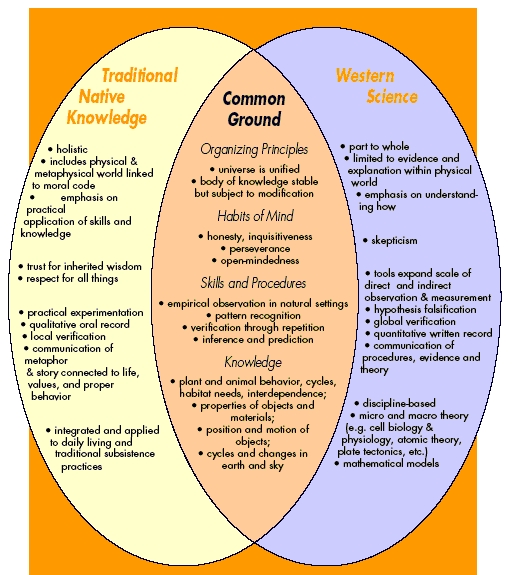
by Ray Barnhardt and Oscar Kawagley
Dr. Lalitha Aswath & Rupesh Kumar A.
full article
Author: Nakata, Martin ; Byrne, Alex ; Nakata, Vicky ; Gardiner, Gabrielle
See on the same shelf:
Sunday, October 12, 2008
Which flavour does knowledge have on the web?
In recent debates within the KiWi - Knowledge in a Wiki project, the need arose to further refine and find a common understanding of the type of knowledge that is (ideally) managed and processed using (semantic) wikis. One of the proposals evolved around a conceptualization of knowledge put forward by Gabi Reinmann-Rothmeier, also dubbed the “Munich Modell” (Münchner Modell).
In the Munich Modell, knowledge comes in three states of matter: solid (like ice), liquid (like water) and gas (like water vapor).
“Frozen” knowledge is knowledge in its most tangible, manageable form, for instance the type of verified, expert-endorsed information you would find in an encyclopedia like the Encylopedia Britannica.
“Gaseous” knowledge, on the other hand, is knowledge in its least consolidated form: think for instance of the type of heated debate you might have with folks in a pub, which is arguably the least structured, most uncontrollable, but also the most engaging type of knowledge!
And the “liquid” form of knowledge, eventually, is the common knowledge of day-to-day-life. It’s probably fair to say that it becomes obvious mostly when in the process of changing its state of matter: When it is calibrated against “frozen” or informational knowledge or when it is debated, becomes “gaseous” knowledge that informs action. (If you’d like to know more about the Munich model and are able to read German, you might want to download the original article here - PDF, 365 KB). continue reading @ The Semantic Puzzle
Friday, September 05, 2008
5 ways to apply management principles at home
By MERCEDES M. CARDONA
For The Associated Press
(AP) - Five workplace management techniques that experts say can bring harmony at home:
- Mission statements are not only for corporations. Patrick Lencioni, author of "The 3 Big Questions for a Frantic Family," says households should establish first what makes the family unique _ its core values.
- Break down the household into manageable parts
- Get help.
- Develop systems.
- Evaluate progress
Friday, July 18, 2008
what are pricing models available for Online Adverisements ?
Q & A @ LinkedIn
what are pricing models available for Online Adverisements ?
Asked by: Md Abubucker Alathick.
5 Answers | February 15, 2007 in Advertising | Closed
Tuesday, July 01, 2008
Knowledge production in a profession: Use-inspired knowledge revisited
NB. Here is an interesting reflection and input for the bank of change. For a reflection on change, you need to recognize change, manage change and record change in a manner that can facilitate the change. There is much more on this change in the May / June issue of AIIM E-DOC Magazine - PM for ECM.
This sort of strategy also helps as a pathfinder for knowledge production in a profession:
This sort of strategy also helps as a pathfinder for knowledge production in a profession:
Inside Pasteur's quadrant: knowledge production in a profession, Karri A. Holley and William G. Tierney, Educational Studies 01 July 2008
Abstract: In this paper, we examine the current state of educational research through the framework of “use-inspired” knowledge. Previous discussions regarding the nature of educational research have disproportionately focused on the soft/applied nature of knowledge in the discipline or a need for methodological priority. After acknowledging these arguments, we consider the role of education as a professional discipline in American colleges and universities, and explore the inherent relationship between researchers and practitioners. Use-inspired knowledge prioritises practice, encourages translational research, fosters interdisciplinarity and dissolves rigid educational structures. |
| Keywords: schools of education; research; professional practice |
| view references (29) |
Friday, June 06, 2008
What Really is Benchmarking?
by Rana Sinha, Apr 10, 2008
Have you ever wondered what Benchmarking really means? Is it just management hype or jargon used by expensive consultants? Here is a short outline of Benchmarking as used in business organizations. ...exxtract:
Different kinds of Benchmarking:
There are basically four different kinds of benchmarking:
>>Internal - Here benchmarking takes place inside an organisation, e.g. between departments or business units
>>Functional - Here benchmarking is done for similar processes within the same field or industry
>>Competitive - Benchmarking operations/processes and performance with competitors in the same field or market is conducted here
>>Generic - Here processes/operations and performance is compared between organisations of similar size in unrelated industries. continue reading
Saturday, May 24, 2008
Microsoft kills Book Search project

From Microsoft's Live Search blog:
"Today we informed our partners that we are ending the Live Search Books and Live Search Academic projects and that both sites will be taken down next week. Books and scholarly publications will continue to be integrated into our Search results, but not through separate indexes."
Full blog posting -- Live Search : Book search winding down
info courtesy: Bernie Sloan
Saturday, May 10, 2008
The difference between cooperation and coordination
After writing our paper on collaboration there were several things we wanted to explore that just wouldn't fit into the original work. We are interested in when it's unhelpful to collaborate, examples of when collaboration has failed, and how collaboration differs from similar terms such as co-operation and co-ordination. continue readingSee also on the same shelf:
A Definition of Collaborative vs Cooperative Learning, Ted Panitz (1996)
Saturday, February 23, 2008
Researching with Wikipedia: The Experiences of Experienced Librarians
I'd like to say that I do everything in my power to scare students away from Wikipedia in the instruction sessions I lead.A quote from 'Many hands make crappy work' New Jack Librarian's blog: "Its largely unsaid, but Wikipedia is thought to improve by means of a strange evolution-like process...
1. Anyone, irrespective of expertise in or even familiarity with the topic, can submit an article and it will be published.
2. Anyone, irrespective of expertise in or even familiarity with the topic, can edit that article, and the modifications will stand until further modified.
Then comes the crucial and entirely faith-based step:
3. Some unspecified quasi-Darwinian process will assure that those writings and editings by contributors of greatest expertise will survive; articles will eventually reach a steady state that corresponds to the highest degree of accuracy." see also: Read about Griefers. Then be oneThis post is based on what was discussed by some participants of the collib-l@ala.org forum. Many voiced their concerns, happiness, and / or tragic experiences, and came up with solutions that would probably work-well. It is hoped that some of these annecdotes will be useful in the area of evidence-based librarianship. Otherwise, are we willing to agree with some who say: today's librarians do "less complex work."
Following is some of that discussion reproduced with the permission of the respective voices."I warn against citing Wikipedia as the credibility of the author is, by definition, unknown." Michael Simmons, Reference & Instruction Librarian, James Addison Jones Library, 815 West Market Street, Greensboro, NC 27401
I do make it very clear to the students that no resource is perfect; there will always be the occasional error. But, this is entirely different from Wikipedia, where "errors" are often intentional. Look at the need to lock controversial topics such as "The Holocaust," "abortion," and "evolution." I tell my students that any information they glean from Wikipedia for academic use must be confirmed in another, more reliable resource. So, why in the world would they double their work? I've had one or two pro-Wikipedia students respond that the errors are caught and corrected. Well, sometimes they are and sometimes they aren't. But, what if a student uses the article prior to an error (intentional or not) being corrected? Yes, there are occasional errors in professional/academic encyclopedias and other resources. But, these errors are rarely -- if ever -- intentional. If a student uses a reputable resource such as Britannica or Academic Search Premier and there is an error in the article, that is not the student's fault. But, if a student uses an article from Wikipedia, which is in no sense a reputable source, then the majority of blame is on the student (and will no doubt be placed as such by their professor). I tell my students that if they're curious about the history of the yo-yo, or want to learn more about Darth Vader, then feel free to use Wikipedia. But, if they need the information to be the slightest bit reliable or in any way scholarly, then never go near Wikipedia. I strongly feel that just because students are familiar with a source and therefore comfortable using it, that doesn't mean we should teach it in our instruction sessions. I am surprised at how many librarians are so open to using Wikipedia. I don't understand why so many librarians countenance the use of such an unreliable (sometimes intentionally so) source.
I disagree entirely that the logical conclusion here is to scare students away from search engines. Search engines are creatures altogether different from an amateurish, unreliable encyclopedia anyone can create articles for or alter in, unless of course said articles have been locked because too many people have already been altering them maliciously.
We do indeed provide guidance when it comes to search engines. But, I think it's entirely within our bailiwick to do our best to steer students away from unreliable, mostly useless resources such as Wikipedia. I suppose if one wants to show students an example of a very bad resource, then Wikipedia serves a purpose. But, why not concentrate on providing them with good resources?
With regard to instruction sessions, I have lost count of the number of subject faculty who have thanked me for reinforcing what they already tell their students with regard to Wikipedia. One professor, in fact, told me outright that he would have serious reservations with regard to bringing in a class for instruction if he knew that Wikipedia was being mentioned as a viable information resource. He tells his students right up front that any paper citing Wikipedia will be returned ungraded and won't be accepted until all uses of Wikipedia are removed.
Robert Daniel Vega
Reference Services Librarian
Christopher Center for Library and Information ResourcesValparaiso UniversityValparaiso, IN 46383Ph: 219-464-5023
Fax: 219-464-5972
This is an interesting discussion and I can see both sides: On one hand there is good evidence of Wikipedia’s unreliability (i.e. the well-documented John Siegenthaler and Diebold Co. incidents as well as Wikipedia founder Jimmy Wales posting false biographical information about himself.) Wales , by the way, earned some startup money for Wikipedia by running a porn portal called “Bomis.” And then there was Massachussets Rep. Martin Meehan whose staff was caught deleting unflattering information from a biographical site about him, and on and on – so many that someone had to invent the “Wikiscanner” to root out false information posted by companies and individuals. (I urge you to read “Wikipedia and Beyond.” By: Mangu-Ward, Katherine, Reason, 00486906, Jun 2007, Vol. 39, Issue 2.)
On the other hand – Wikipedia seems like a grand venture linking vast numbers of bits of knowledge contributed by millions of individuals in the quest for truth and wisdom. I use it a lot, but always seek verification from other sources and that’s what I advise my students to do as well. I also tell them it’s a good place to start, but like any encyclopedia, it is not an appropriate source for college-level work.
In the end, I hope Wikipedia succeeds with providing great information, but am pessimistic because it is falling prey to vandals and greed.
Garet Nelson, Director
Samuel Read Hall Library
Lyndon State College
Lyndonville, VT 05851
( 802.626.6446 A year or so ago, I decided to learn about Wikipedia by contributing to and significantly expanding a short article. The subject of the article (a person) was one about which I have written a scholarly (and published) book. The person, dead for some time, is still of interest to many people, since he was a religious figure. To make along story short, "my" article was rather quickly hijacked by a person who has contributed and edited a great many Wikipedia articles having to do with Christianity, and he (I've always assumed it was a"he") has a clear conservative bias.
We argued through the discussion section for some months, generally about how this figure should be presented. He had enjoyed some fame before he became religious, and over the course of his life he became a cultural hero of sorts; I wanted to present that part of his influence. Nope; only the subject's theology and conservative credentials were important to the hijacker. Over and over I had to refer the hijacker to the source literature to back up something I had written that he disliked; it was apparent that he had not read agreat deal about the person before then. Eventually I just got worn out, and I gave up and declared defeat in the "edit war." Since Wikipedia is anonymous, I never revealed that I was the author of one of the books that I cited, and the hijacker never revealed his identity either.
I remain displeased with that Wikipedia entry. Although it is lengthy and there is a lot of good information in it, there is also extraneous material that doesn't contribute to our understanding of the subject, and a very important facet of the subject's life isn't discussed. I don't consider the article to be as useful a presentation of his life, influence, and importance in American culture and history as it could be.
An article can be long and reasonably well written and still not beas informative and/or as objective as we assume encyclopedia articles should be. There are Wikipedia contributors who are bullies, and there are contributors who have an ax to grind. (Perhaps I have an ax to grind, but I'm not much of a bully.) Although it is possible for anyone to correct an inaccuracy, it is also possible for those corrections to be deleted or corrected again. Inaccuracies are in the eye of the beholder.
The moral of this story is......Democracy is a messy business. Town meetings are great political instruments, but the discourse is messy. Caveat emptor.
About Wendy Knickerbocker
Wendy Knickerbocker,
Your good story of misadventures with Wikipedia echoes my own experience.
Fan that I am, I first dipped my toe into the Wikipedia morass in order to test it. I set up several articles, and so as you did I quickly learned my limits regarding both technique and my chosen topics. Only they were wrong about the topics: I did know a great deal about those...
Like you, then, I discovered several things about democracy. First, I learned that Wikipedia is _not_ one. There even is an article asserting and explaining that, on Wikipedia itself.
Also I was reminded, several times brutally, that pure democracy is not necessarily a good thing, that republics can be better, that separation of powers and tripartite government and regulatory bureaucracy all are needed, that all systems require transparency -- and that Wikipedia neither addresses nor even acknowledges any of the above, yet.
That's all for my next article on the Wikipedia effort, the one I'll write when I've calmed down from my anger at anonymous know-nothing nuts and meddling power-mad administrators who messed me up the last time, there...
I encourage you very much to write up and publish your own Wikipedia critiques as well, Wendy, relating and elaborating upon the frustrations you describe below: if you get one done please send me the cite, as I'd like to read it.
But the pressing issue for you and me and most of us now, I think, is how to define and grapple with the Wikipedia beast as it now presents itself, current warts and all. It is extraordinarily useful, and extraordinarily well-used: we need to understand it.
One day, or perhaps over time, we all may have a chance to improve it, to alter its direction: that is Jimmy Wales' ultimate hope, I believe, and if so I share it -- Wikipedia appears to be growing beyond the size and scope of anything he or any small group might control, like so many other things about the Internet, so perhaps We The Users ultimately will run it after all. Democracy, then.
In the meantime, though, that's not it. Nothing democratic or really otherwise, in the way you and I and others have been roughly handled, by the current -- interim, maybe -- Wikipedia administrative structure or lack thereof.
So what exactly happened, to us and to others, and by whom was it done, and with what authorities? Wikipedia needs many articles on such questions, if it is to improve as it grows: I hope you will write some.
To just sit & stare, though, or to deny the very existence of the rough & slouching & new Wikipedia beast -- as some in the information (!) professions apparently do -- to me seems at best unprofessional. Librarians, and professors in all disciplines, are in the information professions: students should learn about all information sources -- if only to criticize and even dismiss them, perhaps, but at least they should learn -- and to me it seems incumbent upon librarians and professors to teach them.
And to try them out... Just the way you did, Wendy: homo faber, homo ludens -- try out authoring a Wikipedia page or two and get some real-life / hands-on experience with the thing, play with it a bit -- _then_ a student can sit back and criticize, maybe, but not until.
I bet that Valparaiso prof never really had used Wikipedia himself, just heard about it from others and grandly diss'ed the idea en principe. I once tried showing the then-very-new Internet to a group of very-grand professors, by encouraging them to sit down at the keyboards and try it out themselves: most did eagerly -- professors are curious types, usually -- but one particularly-haughty individual drew himself up and announced, "Personally I do not type, I employ *staff* for that..."
Caveat lector,
Jack Kessler, About Jack:
FYI France (sm)(tm) is a monthly electronic
journal published since 1992 as a small-scale,
personal experiment, in the creation of large-
scale "information overload", by Jack Kessler.
Saturday, January 19, 2008
HBS Cases: How Wikipedia Works (or Doesn't)
For HBS professor Andrew McAfee, Wikipedia is a surprisingly high-quality product. But when his concept of "Enterprise 2.0" turned up on the online encyclopedia one day—and was recommended for deletion—McAfee and colleague Karim R. Lakhani knew they had the makings of an insightful case study on collaboration and governance in the digital world.
HBS professor Andy McAfee had his doubts about Wikipedia, the online encyclopedia created and maintained by volunteers. "I just didn't think it could yield a good outcome or a good encyclopedia. But I started consulting it and reading the entries, and I said, 'This is amazing.' "
So when the concept of "Enterprise 2.0"—a term coined by McAfee on the general idea of how Web 2.0 technologies can be used in business—popped up on Wikipedia, McAfee beamed. "I was bizarrely proud when my work rose to the level of inclusion in Wikipedia." Then, however, a turn of fortune took place. A "Wikipedian" nominated the article for deletion as unworthy of the encyclopedia's standards. McAfee thought, "It's not even good enough to get on Wikipedia?" continue reading
info courtesy: Wikipedia Enterprise 2.0 Story by Aa..ha! [Thinking Inside The Blog!]
Tuesday, January 08, 2008
The Tacit Knowledge of Team Leadership
Posted by Sam Marshall @ Intellectual Capital Punishment
Don't let the title of
Towards an Ecological Theory of Sustainable Knowledge Networks by Jeff Conklin, et al put you off. Its full of insight about project teams (rather than knowledge networks in general). One thing caught my eye:
"The process of team formation is complex. Leaders have tacit knowledge about how to move a team through a process, and they access that knowledge in face to face meetings. When in virtual collaborations, they don't have that, e.g. they may not recognize that they don't have alignment about team goals"
Note that the barrier isn’t lack of knowledge, but the absence of the stimulus needed to retrieve it. The dynamic of the face-to-face interaction is what triggers the intuitive manager to take the right course. He may only sense subliminally the lack of alignment, but he'll intuitively do what it takes to correct that. Few managers would explicitly have a process with a "check alignment" gate, but they all know it must be done. Even bumping into a team member and subsequent chit chat can lead to an explicit awareness that they need information you hadn't thought to pass on. continue reading
Friday, November 09, 2007
Do Knowledge Managers Really Want to Share Knowledge?—Sharing as a Mating Game

Posted by Patrick Lambe:
I’ve had a creeping suspicion for some time that knowledge managers are fine about encouraging others to share knowledge, but that dictum doesn’t apply to them. In my role as President of iKMS I am always trying to get knowledge managers to share, and the ones who do are in the brave minority - even then, they tend to be far more reluctant to share in a public forum than in a private one. They have reasons, of course: lack of experience and confidence, lack of clear progress and successful results to show, restrictions by employers. But in such a young profession, with such instability of career progression and continuity of KM staff, with extensive inexperience among managers who are responsible for KM, sharing is about the only way to get access to experience faster. The obsession with success is an illusion born of that inexperience. We learn fastest through examining lack of success, and the more mature professions such as medicine and law and engineering recognise that. They have rituals for anatomising failure, and it’s not for fun, it’s because that’s how they learn and survive. Continue reading the Guru's words Categories: Communities, Expertise, Ignorance Management, KM Competencies, KM Critiqued, Knowledge Sharing Permalink
See also Patrick Lambe's new book:
Sunday, October 14, 2007
The 18 commandments of Knowledge-conscious managers
"I like the idea that Knowledge Management is really about Knowledge Conscious Management, or to put it differently, Managing in the Knowledge Age as Professor Klaus North puts it. Incidentally, this explains why it is so difficult to introduce in 20th century organizations, which do not recognize mastery of knowledge flows as a source of competitive advantage.
The HR department of my company asked me to write a short memo and call it "the ten commandments of knowledge management". I thought it was a good idea -KM is a faith with its manifesto (e.g Cluetrain)-, but couldn't find enough time to reduce everything to ten commandments, and I have eighteen!
Let me know your thoughts...
1. Don't always challenge. Welcome one another's thoughts and opinions.
Rehabiliate casual conversations and information sharing as a normal business practice that should take at least half of your time. Don't expect to learn a lot just by challenging your staff.2. Experiment constantly. Enlightened trial and error outperforms the planning of flawless intellects
You can, and must, plan ahead to know where you want to go, but then put the plan aside and focus on the first steps. Regularly stop to reflect on the action and repeat the process. click here to continue reading all the Eighteen Commandments ...
Thursday, October 11, 2007
The roles of knowledge professionals for Knowledge Management
65th IFLA Council and General
Conference
Bangkok, Thailand,
August 20 - August 28, 1999
Code Number: 042-115-E
Division Number: VII
Professional Group: Education and Training
Joint Meeting with: -
Meeting Number: 115
Simultaneous Interpretation: Yes
The roles of knowledge professionals for Knowledge Management
Seonghee KimFaculty of Library and Information Science
Dongduk Women's University
E-mail: shkim@www.dongduk.ac.kr
Abstract
Knowledge and Knowledge Management have emerged as a current 'hot issue' for many organizations. This paper starts by exploring the definition of knowledge and knowledge management. It then considers the partnership for knowledge management, and especially how librarians as knowledge professionals, users, and technology experts can contribute to effective knowledge management. It is concluded that knowledge professionals will have to move from the background to the center of the organizational stage, to jointly hold the reins of knowledge management. Read the Full articleSaturday, October 06, 2007
Relationship of KM with other functions in an organization

Interesting insights on holistic approach to knowledge management, as well an integrated perspective that is within the framework of an organizational culture, is presented by Sujatha Das @ Learning & Knowledge Center
Monday, October 01, 2007
Knowledge Audit: Is it Necessary for Your Organization?
KnowGenesis is a freely available, international, scholarly journal, dedicated to making accessible the results of research across a wide range of information-related disciplines under Technical Communication. KnowGenesis publishes both referred papers and working papers in the fields of technical communication, documentation, information science, information and technology management, information systems and information policy.
Read the
Panel Discussion on " Knowledge Audit: Is it Necessary for Your Organization?" Led by Ginu George
PS. To access the journal online, you'll need your login ID and password.
For FREE registration, visit the registration page
(http://www.knowgenesis.net/journal/index.php?
journal=IJTC&page=user&op=register) or e-mail your registration
request to editorinchief@knowgenesis.org.
NB. Panelists: Prof. A. Neelameghan, Dr. L. J. Haravu, Mr. Bhojaraju D Gunjal, Mr. Ginu George, and Dr. Mohamed Taher
See also:
If We Can’t Even Describe Knowledge Sharing, How Can We Support It?
Saturday, September 01, 2007
The Challenge for Health Sciences Librarianship...
We need--A more focused research agenda
- Evidence-based librarianship
- A clear vision for librarians’ role in the knowledge management process
- A strategy for educating and training the next generation of librarian knowledge managers
Continue reading [ppt file]: Informationist and Expert Searcher: Critical New (Old) Roles for Health Sciences Librarianship? by Gary D. Byrd, Ph.D.,
University at Buffalo (SUNY)See also on the same shelf: The health sciences librarian as knowledge worker
Library Trends , Summer, 1993 by Valerie Florance, Nina W. Matheson
Sunday, August 19, 2007
PRODUCTIVITY: Brainstorming - Ten Guidelines
10 Guidelines for Effective Brainstorming
By Randah Taher
The Ten Commandments (see also the pdf version):
1. Come prepared. And invite others to do so too.
2. Invite others to the party.
3. Think and re-think the real issue.
4. Record as you go.
5. Defer judgement.
6. Become a generator machine.
7. Force large quotas.
8. Elaborate and improve.
9. Enhance visuals.
10. Threaten yourself.
What others say about all-of-the-above:
@ LifeChurch.tv
Enterprise innovation made easy: Jenni Idea Management Software Service
By Randah Taher
Brainstorming is a powerful tool, if used correctly, but just like any power tool, you must read the manual, follow instructions and use the thing correctly…or you’re wasting time. Randah Taher presents 10 guidelines to optimizing the power of brainstorming. source
The Ten Commandments (see also the pdf version):
1. Come prepared. And invite others to do so too.
2. Invite others to the party.
3. Think and re-think the real issue.
4. Record as you go.
5. Defer judgement.
6. Become a generator machine.
7. Force large quotas.
8. Elaborate and improve.
9. Enhance visuals.
10. Threaten yourself.
What others say about all-of-the-above:
Subscribe to:
Posts (Atom)


 Profile of emerging leaders. This list continues to grow. To view
 Posts
Posts


 More about (my new home) Google sites and the old home, READ